


Author: Oliver Cromme, Global Product Manager Refiner/Deflaker
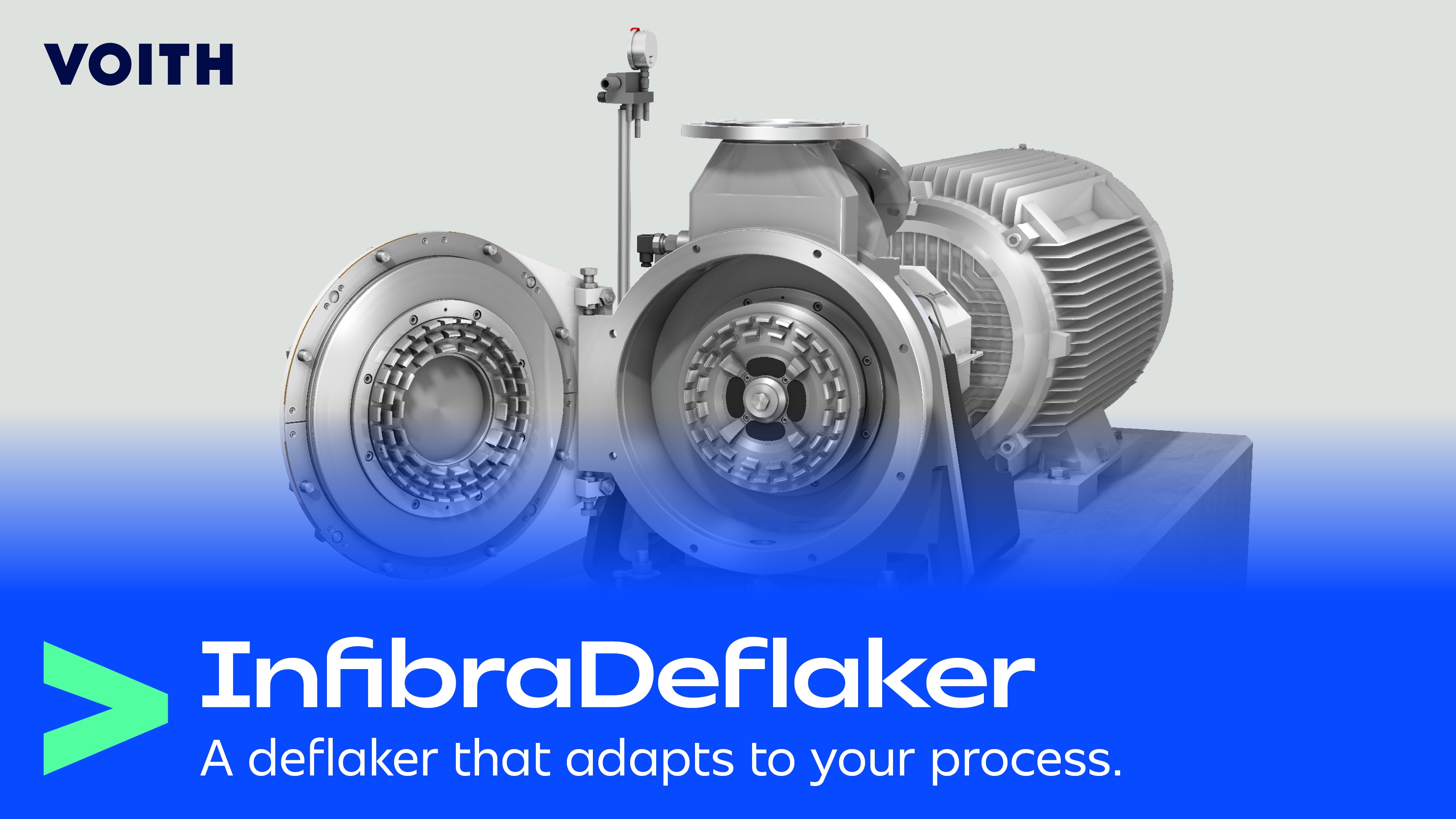
With the launch of the InfibraDeflaker, Voith is expanding its BlueLine portfolio for modern stock preparation lines. The innovative modular design features a single- and double-disc configuration for greater flexibility in production. Further upgrades on Voith’s proven deflaking technology improve runability, reduce maintenance effort and secure a longer service life.
Drawing on more than six decades of experience and over 4,500 installed deflaking units, Voith engineers set out to refine key aspects of deflaking technology and bring it in line with the standards of the Voith BlueLine portfolio for modern stock preparation. With the launch of Voith’s InfibraDeflaker, papermakers can now respond more effectively to everyday operational pressures.
First introduced a decade ago, BlueLine now spans more than 20 product families, from the first InfiltraDiscfilter in 2014 to the smart InfibraFiner in 2024, and now the InfibraDeflaker. Each BlueLine component is aligned and designed to support higher runability, greater resource efficiency and simplified operation and maintenance.
The new InfibraDeflaker is part of Voith’s broader effort to modernize and streamline key process steps in stock preparation and the wet end process.
As with other new BlueLine innovations, the InfibraDeflaker was developed with a clear focus on the real mill conditions and the changing demands of papermaking. As Astrid Giltjes, Product Marketing & Industrial Design Fiber Systems at Voith, explains, having a deep understanding of the day-to-day operations in mills enabled the InfibraDeflaker team to scrutinize existing approaches to deflaking and identify areas where practical improvements were feasible.
“What we’ve achieved with the InfibraDeflaker is a modular design that allows a more flexible approach to production capacity,” says Giltjes.
“By building on proven technology and applying modern industrial design principles, we offer a system that adapts to real mill conditions, improves resource efficiency and makes maintenance procedures significantly easier to carry out. At the same time, our robust design ensures consistent performance over a longer service life.”
Flexible single- and double-disc configuration
Production lines do not always run as originally intended. Machines are designed for maximum capacity, but the actual production line often runs below those levels, sometimes significantly. The result is inefficient use of resources, higher energy consumption, and more wear than necessary.
The InfibraDeflaker efficiently handles such changes in production capacity. The same unit can run in two separate setups. The modular rotor design operates in both single- and double-disc configurations (Fig. 1). This flexibility enables papermakers to adjust and align the deflaker to actual production requirements and flow conditions without the need for additional machines. Switching between configurations can be carried out within less than an hour.
In practice, this means that mills can adjust the InfibraDeflaker to run within much wider operating windows. Depending on the fillings, due to the modular rotor design throughput levels of up to 1,000 l/min (nominal flow) are generally recommended for the single disc, while the double-disc configuration allows throughput up to 2,000 l/min (nominal flow). In the overlapping operating range, single-disc operation can reduce energy use and wear on internal components
As papermakers can run the modular configuration at a lower capacity, they can considerably reduce both energy use and wear. The InfibraDeflaker can be easily switched over to the double-disc configuration when production capacity is scaled up again. The change is not something that mills have to make particularly often, but the solution addresses inefficiencies in production lines. “The InfibraDeflaker is a single, flexible unit,” adds Bernd Vogel, Technical Sales Manager at Voith Paper. “Our solution adapts to real-world operating conditions with a more efficient setup. Over time, the efficiencies add up, especially in terms of energy and manual effort.”
Simplified design for ease of maintenance and higher runability
Alongside enabling greater operational flexibility, reducing maintenance was a key focus of the upgrades.
The InfibraDeflaker features a compact, robust housing, a watercooled cartridge bearing and an integrated mechanical seal. The cartridge bearing can be removed and replaced as a complete unit without dismantling the machine, which significantly reduces maintenance time and effort.
During operation, seal water is routed through the cartridge bearing. This helps reduce the thermal load, which is invariably generated at high rotational speeds. Cooling down the cartridge bearing stabilizes operating conditions and supports a reliable, uninterrupted deflaking process.
Taken together, these improvements reduce wear, improve runability, and support a more consistent performance over an extended service life.
The core process improves fiber processing, reducing costs
In addition to the flexible configuration and reduced maintenance requirements, the InfibraDeflaker is designed to support efficient fiber processing.
During stock preparation and the wet end process, common problems include fiber bundles and flocs, which can lead to an inhomogeneous suspension. The role of the deflaker is to loosen and homogenize stock suspension, which helps prevent paper breaks and avoid unplanned downtimes.
The InfibraDeflaker uses a controlled combination of acceleration and deceleration processes to break down fiber bundles into uniformly dispersed individual fibers without damaging the fibers or reducing their strength. This energy-efficient approach increases fiber yield and ensures more consistent and uniform results, making it the ideal solution for OCC screening applications (Fig. 3). Voith also offers a broad filling portfolio, enabling fine and coarse deflaking across all raw materials.
While the fiber savings vary and depend greatly on production conditions, field studies on OCC stock preparation lines indicate that fresh fiber use can be reduced by up to 25 percent. (Fig. 4).
Targeted improvements for measurable impact
In a mature process such as deflaking, progress is driven by targeted improvements that make the machinery easier to operate, maintain and adapt to actual production capacity, as well as optimizing fiber processing. The InfibraDeflaker brings real value to papermakers by improving everyday operating conditions and outcomes.
“With the InfibraDeflaker, we have deliberately focused on practical advantages for day-to-day mill operation,” says Steffen Bassmann, Head of Product Management Fiber Systems at Voith Paper. “The combination of flexible configuration, simplified maintenance and robust design allows customers to stabilize their processes while reducing operational complexity.”